
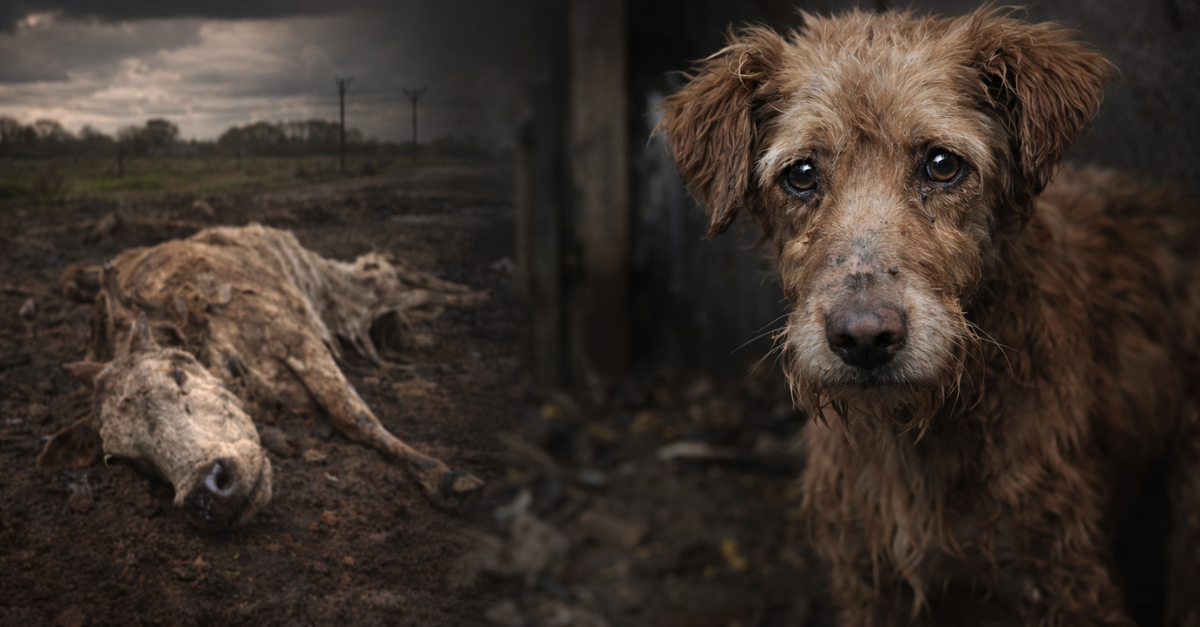
While our legislation, the Animal Health and Welfare Act 2013 [1], is designed to protect animals from harm, a series of recent court cases has amplified a debate over whether the judiciary is too lenient on those who break the laws governing animal welfare. By looking past the legal jargon and into the dark sheds and desolate fields where these animals lived, we can ask: does the punishment truly fit the crime?
The Veterinary Inspector: Michael O’Reilly
Perhaps the most jarring case involves Michael O’Reilly, a man whose professional life was dedicated to enforcing the very standards he was convicted of ignoring. In 2024, inspectors discovered ten Irish terriers at his kennels in Co. Cork living in conditions described as “atrocious” [2].
Michael O’Reilly, a Department of Agriculture veterinary inspector convicted of animal cruelty in Co Cork, was originally sentenced by Judge Colm Roberts at Midleton District Court in May 2024.
The animals were found in dark, cramped sheds, surrounded by mounds of their own faeces and infested with rodents [2][3]. The smell of ammonia, the result of accumulated urine, was so overpowering it burned the senses [4]. These were not just neglected animals; they were show dogs kept by a professional vet who was simultaneously working for the Department of Agriculture [3].
- Sanctions: Initially banned from keeping dogs for seven years
- The judge imposed fines of €4,000, ordered him to pay €5,000 costs noting the fact that he was a vet was an aggravating factor. [2]
- 3 month suspended sentence
- On appeal in December 2024 to the Circuit Court, the three month suspended sentence and €5,000 in legal costs to be paid was upheld, but the fines payable were reduced from €4,000 to €2,000. The blanket ban was removed. [5]
- He was permitted to keep his nine existing dogs until the number reduced to four. The four dog limit to last for 6 years [5].
- Professional Status: While the court noted he was “likely to lose his job” [5] it is unclear if he is still employed by the Department of Agriculture or if he faced any internal disciplinary proceedings. [6][7]. As of the date of this article, he is still on the Veterinary Council of Ireland register as a Veterinary Practitioner, with no results of any professional conduct hearings, if any, available publicly.

The Abandoned Herd: Denis O’Regan
In January 2026, the case of Denis O’Regan of Coachford, Co. Cork highlighted a different kind of horror. Vets described the scene on his farm as the “worst they had ever seen” [8].
Based on recent reports, the Cork farmer who pleaded guilty to severe animal neglect in a case heard at Macroom District Court, which concluded on January 14, 2026, was sentenced by Judge Joanne Carroll
Inspectors found the decomposing carcasses of 30 cows and calves strewn across the land [9]. The survivors were emaciated, living in pens that had not been cleaned for months, providing no dry place for the animals to lie down [8]. The judge noted the “shocking” level of neglect, highlighting that O’Regan had let his stock numbers spiral far beyond his ability to manage, leading to systematic starvation [10].
- Sanctions: A 15-year disqualification from keeping animals (allowing only to keep his three cats) and a three-month suspended sentence [9][8]. He was fined €3,000 and Dept of Agriculture, Food and the Marine prosecution costs of €7,500 plus VAT. [8].
The Protest Leader: James Geoghegan
James Geoghegan, a prominent voice in the 2026 fuel protests, carries a legacy from 2006 that resurfaced as he stepped into the public eye. Convicted of 13 charges of animal cruelty, the details of his Westmeath farm remain a grim reminder of lack of oversight [11].
The presiding judge has not been identified in publicly available reports.
The case involved 13 counts of animal cruelty and neglect after between 60 and 65 cattle died on his farm in Cornahar, Kilbeggan, Westmeath. During the proceedings, Geoghegan claimed the situation arose due to a relationship breakdown and his hired help leaving. He was convicted on all 13 charges.
Between 60 and 65 cattle died on his farm over a 13-month period [11]. Offences included; leaving an animal’s head trapped, not burying carcasses, not providing water and not providing a proper diet [12]. Though Geoghegan appears to purport it was not his issue and related to his father’s family – albeit his herd number was in his name. [11]
- Sanctions: In 2006, he was fined €6,250 [12]. There was no report that a ban on owning/keeping animals was imposed. Today, it is reported that he operates as an active agricultural contractor [13].
A Society’s Choice
Is the judiciary “under-penalising” these individuals, or is the system attempting to balance their alleged personal circumstances with justice for animals?

While many cases result in non-custodial sentences, some judges have shown they are not under-penalizing severe cruelty, instead opting for immediate, tough custodial penalties:
A couple from Co Monaghan who captured their neighbour’s cat and tied it in a bag, before leaving it at a lake, have each been given three month prison sentences. Judge Raymond Finnegan described what happened as “cruel” and “horrendous” behaviour towards an innocent animal.
Judge Finnegan ordered that the Connollys be kept in the court’s prison cell while he reflected on the matter, telling them directly: “You can see how you feel being trapped for a while.”
Finnegan said what the Connollys did was “absolutely out of order”. It was crude, it was horrendous, and to do that to an innocent animal that was “doing what animals do in every garden” was “unspeakable”.
The theft charges were taken into consideration, while recognisances for appeal of the sentence were set at €250 cash in both instances.” [14]
Under the Animal Health and Welfare Act 2013, the maximum penalty for animal cruelty (including by a farmer) is a fine of up to €250,000 and/or up to 5 years’ imprisonment on indictment. On summary conviction in the District Court, the maximum is a €5,000 fine and/or up to 6 months’ imprisonment. Courts may also impose disqualification orders (including lifetime bans on keeping animals), as well as forfeiture and costs orders. [1] [15]
In Ireland, sentencing guidance and judicial training are provided by the Judicial Council (established under the Judicial Council Act 2019 [16][17], including its Sentencing Guidelines and Judicial Studies Committees, but any guidance is non-binding and judges retain full discretion. Judges are constitutionally independent under Article 35, so nobody can direct sentencing; oversight is limited to appeals (for legal decisions) and the Judicial Conduct Committee, which deals with complaints about judicial behaviour but cannot alter judgments.[18][19]
According to a Dáil Éireann Written Answer of 27 February 2025, there have been 181 successful prosecutions under the Animal Health and Welfare Act 2013 [20]. Of these, custodial sentences were imposed in only 10 cases (approximately 5.5%), disqualification orders in 44 cases (approximately 24%), and the Probation Act was applied in 18 cases (approximately 10%).
Recent reported cases highlight material variation in sentencing outcomes, including inconsistent use of disqualification orders, suspended custodial sentences, and conditions requiring completion of “animal welfare” or “animal husbandry” courses.
Disqualification from keeping animals is one of the most protective sanctions available to the courts, yet its use and scope appear inconsistent. In our submission to the DAFM Public Consultation on the Animal Welfare Strategy 2026-2030 we highlighted that consideration should be given to making disqualification the default outcome in serious animal welfare cases, unless the court is satisfied that there are clear and reasoned grounds for departing from this position.
This approach would be consistent with other areas of law where protective measures operate on a presumptive basis, such as the restriction of company directors under the Companies Act 2014 [20], where the onus shifts to the individual to demonstrate why such an order should not be made [21].
Introducing a similar presumption in animal welfare cases, accompanied by clear and standardised wording in disqualification orders, would strengthen the protective function of the law and reduce the risk of circumvention, including situations where animals are nominally transferred to another person residing at the same property.
The application of the Probation of Offenders Act 1907 [22] in animal welfare cases raises particular concerns. According to a Dáil Éireann Written Answer of 27 February 2025, the Probation Act was applied in 18 cases (approximately 10%) of all of the 181 successful prosecutions since 2013 [23]
Animal welfare offences are not trivial in nature; they involve harm to sentient beings and often reflect sustained neglect or cruelty. The Law Reform Commission has noted that where the Probation of Offenders Act 1907 is applied, no criminal conviction is entered against the defendant. While the Probation Act may be appropriate in very limited circumstances, its significant use in animal welfare cases risks undermining deterrence, transparency, and public confidence.
Disclaimer
This article is compiled solely from information currently available in publicly reported court proceedings and media coverage, and is not intended to editorialise, opine, or propose new facts regarding the individuals or cases mentioned.
Sources:
- Animal Health and Welfare Act 2013
- ISPCA Inspection Report: Michael O’Reilly Case (Irish Times)
- Veterinary Inspector Conviction Details (Agriland)
- Kennel Conditions: Faecal Soiling and Ammonia (Irish Examiner)
- Sentence Reduced on Appeal: Blanket Ban Removed (BreakingNews.ie)
- Department Employment Status Reports (Facebook – Murphy and Me)
- Disciplinary Action Updates (Laois Nationalist)
- Denis O’Regan Case: “Worst Vet Had Ever Seen” (Independent.ie)
- Cork Farmer Banned for 15 Years (RTE)
- Judicial Remarks on O’Regan Neglect (Irish Farmers Journal)
- James Geoghegan 2006 Conviction History (RTE)
- Specific Conditions on Geoghegan Farm (Independent.ie)
- Current Status of Fuel Protest Leader (Business Post)
- Retired couple who abducted neighbour’s cat and tied it in a bag jailed for animal cruelty
- Judicial Council Act 2019 (Ireland)
- Judicial Council Act 2019 (as enacted – Irish Statute Book)
- Section 43 – Judicial Conduct Committee (within the Act)
- Judicial Conduct Committee (overview page)
- Animal Welfare Convictions
- Companies Act 2014
- Law Reform Commission, The Court Poor Box: Probation of Offenders (LRC 75–2005)
- Probation of Offenders Act 1907
- According to a Dáil Éireann Written Answer of 27 February 2025
