
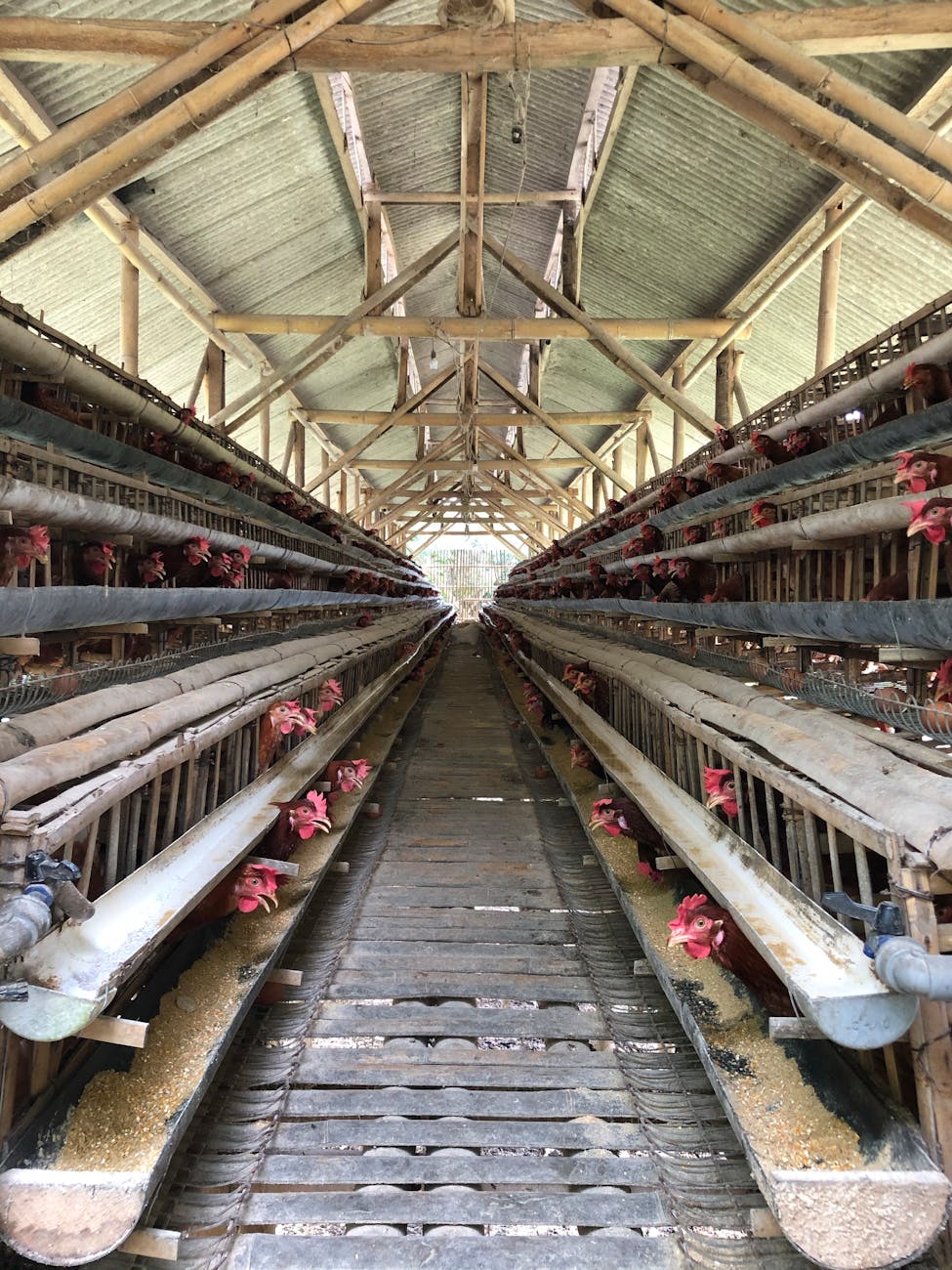
Imagine a world where millions of farm animals across the EU finally get the room to move, stretch, and live with dignity — not locked away in tiny metal cages. That world might be closer than you think. A new public consultation on farm-animal welfare is now underway, and this is your chance to help end cage confinement once and for all.
By lending your voice before 12 December 2025, you could help shape EU legislation that could transform the lives of hens, pigs, calves, rabbits and more — giving them a real shot at a cage-free future. Will you speak up for animals who can’t speak for themselves?
The aim of the European Commission survey is to revise EU legislation regarding on-farm welfare, including phasing out the use of cages.
Give yourself about 30 minutes to get registered and to fill in the survey.
Deadline
12 December 2025 (midnight, Brussels time)
How to Make a Submission
- You can submit your responses in any official EU language.
- The EU survey form is not the easiest form to fill in, but think about the lives of the animals you could impact by taking the time to respond to the consultation.
- Tip: We have provided details of the questions in the survey further down this web page.
- Tip: A gap we have noticed on the survey is the mention of equines (horses) and fish. These animals are also farmed for food production. There are some free text spaces where your own thoughts can be added in.
- For reasons of transparency, organisations and businesses taking part in public consultations are asked to register in the EU’s Transparency Register.
Make a Submission – Option 1
- Register with the European Commission website for public consultations.
- Enter your name and email address to create an account. The website is very slow, but wait for it to update.
- You will see a notice that says “Thank you for registering, you will receive an email allowing you to complete the registration process.”
- When you receive the email, click on the link to create a password.
- Keep the password safe, for the next step.
- Go to the survey on the European Commission website.
- Click on the link “Respond to this questionnaire“.
- Enter your email address and password.
- Choose an option under “Choose your verification method“. If you don’t know what this means, choose “Password” from the drop down menu.
- Fill in the survey.
Make a Submission – Option 2
- Send an email with your submission to SANTE-CONSULT-G3@ec.europa.eu.
Tip: Take a look at the questions below to help you with your response.
Make a Submission – Option 3
- Use the handy form on the Eurogroup for Animals website.
This is a much easier way to make a submission – this tool helps you fill in the consultation in less than 5 minutes.

How Many People Have Made a Submission?
At the time of writing, 29 November 2025, only 54 people from Ireland have made a submission.
Over 70,000 people from Germany have made a submission. View the latest statistics on submissions.
I Have Made a Submission, What Else Can I do?
Share on Social Media
Use the hashtag #ForwardforAnimals.
Why is this survey taking place?
Under the Vision for Agriculture and Food of 19 February 2025, the Commission has announced its intention to closely exchange with farmers, the food supply chain and civil society and on that basis to present legislative proposals on the revision of the existing EU animal welfare legislation, including to follow-up on its commitment to phase out cages. The Vision also sets out that the Commission will make sure that future legislative proposals on animal welfare apply the same standards to products produced in the EU and those imported from non-EU countries in a WTO compliant way and based on an impact assessment.
The Commission’s fitness check of the EU animal welfare legislation in 2022 concluded that the current legislation is no longer fit for purpose. Neither is it aligned with societal and ethical expectations. One example of such ethical concerns is the ‘End the Cage Age’ European Citizens’ Initiative, to which the Commission has responded positively in 2021 by committing to propose legislation to phase out the use of cages for certain categories of animals.
There is an interest across the livestock industry in modernising the animal welfare legislation by better using animal welfare indicators, to bring more flexibility and to simplify compliance and enforcement. Stakeholders have also called for EU animal welfare rules to apply to imports in line with international rules.
On 12 May 2025, the Commission announced its intention to modernise the EU rules for on-farm animal welfare in line with the objectives of the Vision.
Further to the Call of Evidence, which was launched in June 2025, this consultation aims to gather feedback from a wide range of stakeholders, including citizens, economic operators, trade and consumer associations, NGOs, research institutes, academia, and non-EU stakeholders. Your input is valuable in helping us assess the current situation and helps ensure that any future legislation is evidence-based, proportionate, and aligned with societal expectations and economic realities.
What are the questions in the survey?
1. Questions about the current situation of animal welfare in the EU
(you will be asked to rate each of these statements)
- EU legislation regulating animal welfare at farm level does not ensure that farmed animals can express normal behaviours.
- Unnecessary administrative burdens for EU farmers and business operators result from the coexistence of EU regulation, national rules, and private standards.
- The broad or unspecific nature of some EU requirements lead to differences in how Member States enforce them, creating distortions in the internal market
- Food of animal origin coming from non-EU countries should have equivalent animal welfare standards to those of the EU.
- EU rules need to align with societal expectations regarding the treatment of farmed animals, such as phasing out cages for certain animals.
- The systematic killing of male layer chicks in the laying hens’ sector is ethically problematic.
Questions on potential future actions at EU level:
2. How important is it that the revision of the EU legislation for on-farm animal welfare contributes to the respective main objectives of the EU Vision for Agriculture and Food?
(you will be asked to rate each of these statements)
- An agri-food sector that is competitive and resilient.
- An attractive and predictable agri-food sector.
- A future proof agri-food sector that is functioning within planetary boundaries.
- An agri-food sector that values food, fosters fair working and living conditions.
3. How important is the phasing out of cages for certain categories of animals?
(you will be asked to rate how important phasing out cages is for each of these types of animals)
- Laying hens
- Pigs
- Calves
- Pullets (young chicken)
- Broiler breeders (meat-chicken for reproduction)
- Layer breeders (egg-laying chicken for reproduction)
- Rabbits
- Ducks
- Geese
- Quail
4. Which barriers do you consider most significant in moving away from cage systems?
(you will be asked to rate each of these statements)
- High investment costs
- Lack of technical knowledge/support for alternative production methods
- Uncertainty around market returns
- Space and infrastructure limitations
- Labour availability
- Lack of consumer willingness to pay
- Other
5. Which is/are the most important supporting measure(s) needed to ensure a smooth transition into a cage-free farming system in the EU?
(you will be asked to rate each of these statements)
- EU public funding, e.g. through the Common Agricultural Policy
- National public funding
- Public-private partnership to facilitate loans (e.g. through the European Investment Bank)
- Long transition periods
- Farmer-to-farmer technical advice
- Production method information, e.g. through marketing standards
- Information campaigns
- Species-specific technical guidance documents
- Other
6. Which of the following elements could contribute most to simplify the overlapping of animal welfare rules applicable to farmers and reduce administrative burden, while ensuring improved animal welfare outcomes?
(you will be asked to rate each of these statements)
- Clearer and more operational legal provisions
- More harmonised EU rules / less freedom for stricter national rules
- Clearer roles and responsibilities
- Wider use of digital monitoring tools
- Greater reliance on outcome-based welfare indicators
- Other (please specify) (the form appears to not allow free text to be entered for this question, unfortunately).
- None of the above
7. To what extent should imports of animal products comply with equivalent animal welfare standards to those applied in the EU?
(you will be asked to rate each of these statements)
- Poultry meat and meat products
- Eggs and egg products
- Pork and pork products
- Veal, beef meat and meat products
- Milk and dairy products
- Rabbit meat and meat products
- Other
8. Which supporting measures could facilitate the transition to equivalent animal welfare standards in third countries?
(you will be asked to rate each of these statements)
- EU training and technical support
- Long transition periods
- Production method information, e.g. through marketing standards
- Support through multilateral instruments
- Species-specific technical guidance documents
- Other
9. To what extent could clearer and more consistent EU rules on on-farm animal welfare help ensure fairer conditions for farmers across Member States?
(you will be asked to rate each of these statements)
- VERY LARGE EXTENT
- LARGE EXTENT
- NEUTRAL
- NOT VERY LARGE
- NOT LARGE AT ALL (the current system is sufficient)
- DO NOT KNOW / NO OPINION
10. In which ways, and to what extent, could the use of animal welfare indicators (e.g. behaviour, injuries, mortality) help to improve animal welfare on farms?
(you will be asked to rate each of these statements)
- By improving the enforcement of animal welfare rules on farms
- For benchmarking purposes, e.g. helping to identify farms with higher animal welfare standards
- By supporting policy monitoring, i. e. tracking how Member States implement animal welfare objectives
- OTHER
11. To the extent that affordable alternatives to the systematic killing of male day-old chicks in the egg production sector are available, how urgent is it for the EU to require the use of such alternatives?
(you will be asked to rate each of these statements)
- VERY URGENT
- URGENT
- NEUTRAL
- NOT VERY URGENT
- NOT URGENT AT ALL
- DO NOT KNOW / NO OPINION
12. a) In your view, what are the most important changes that should be made to the current EU legislation on on-farm animal welfare?
(Free text answer allowed)
12. b) How can these changes be designed or supported in a way that also enhances the competitiveness and long-term resilience of the EU livestock sector?
(Free text answer allowed)
13. Do you have any additional comments, views, or evidence to share related to the revision of EU legislation on on-farm animal welfare?
(Free text answer allowed)
Further Information on the Consultation
2022 Fitness Check of the EU Animal Welfare Legislation
The initiative will explore several options to address certain shortcomings identified in the 2022 fitness check of the EU animal welfare legislation.
